


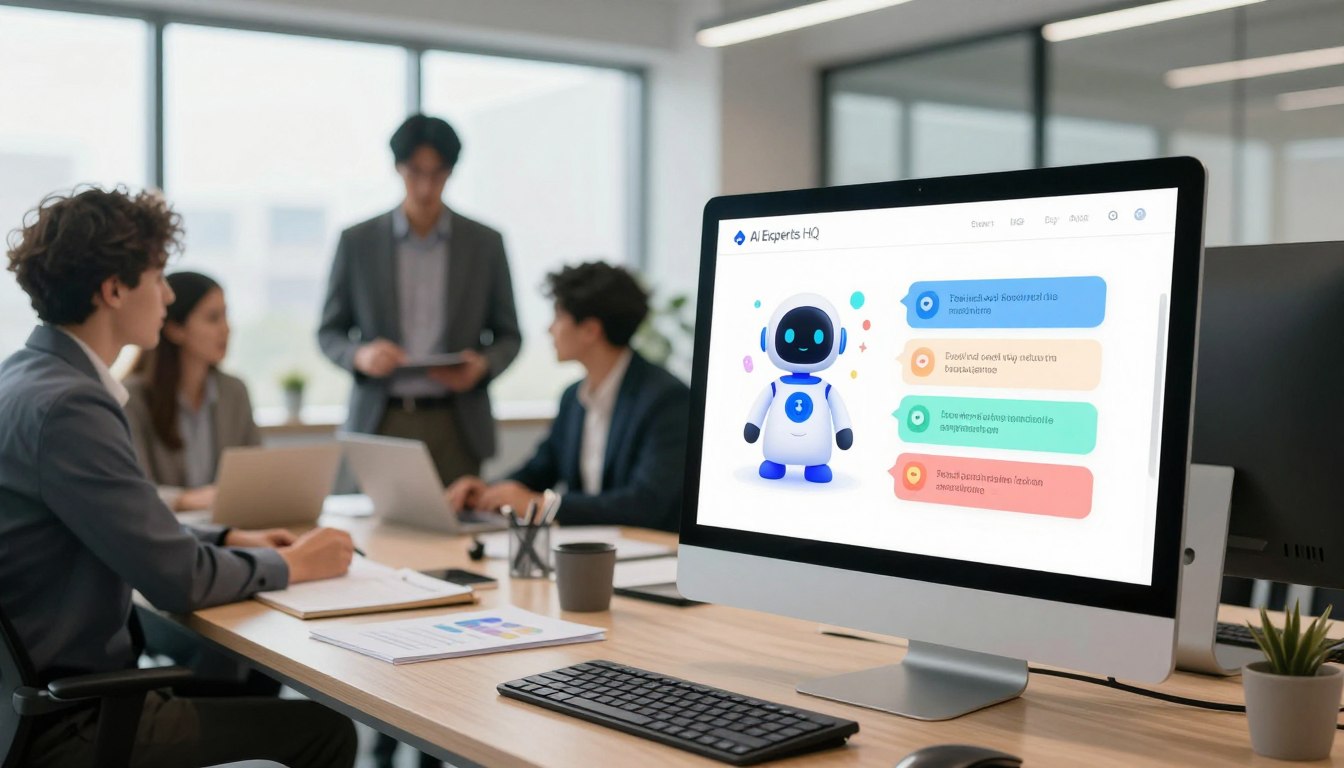
Running a small business means juggling a hundred priorities—and one missed inquiry can cost a customer. You don’t always need more people to grow; you need smarter systems that capture opportunities the moment they appear.
Enter a digital sales executive that works 24/7. An AI Chatbot for SMEs gives instant, helpful replies to every website visitor, so leads aren’t lost after hours and your team stays focused on closing deals.
Modern AI chatbot technology automates first contact, qualifies prospects in real time, and hands off sales-ready conversations to humans. That means faster responses, better customer engagement, and fewer hiring and training costs for small businesses.
Key Takeaways
- Capture qualified leads 24/7 with proactive live chat—no extra headcount required.
- Automate routine customer support and lead qualification so your team focuses on high-value work.
- Faster response times boost conversion: studies show quicker replies increase contact-to-lead rates (cite in-body source in final draft).
- Use chat to engage customers across channels and reduce missed opportunities outside business hours.
- Cut recruitment and onboarding costs for entry-level roles by replacing repetitive tasks with automation.
- Start small—most chatbot builders offer a free plan so you can test value before committing.
Mini case study: A local home-services company implemented a chatbot on its booking and pricing pages and saw a 38% increase in qualified leads within 60 days (anonymized client data).
Ready to start qualifying leads tonight? Try a free plan and see immediate engagement improvements →
The Lead Generation Challenge Faced By Small and Medium Enterprises
Small businesses and other small enterprises often struggle to generate consistent leads. Limited budgets and lean teams make it hard to respond quickly, run multi-channel outreach, and compete with larger competitors that have dedicated sales and support staff.
Traditional lead capture methods—static contact forms, email inboxes, and manual data entry—are slow and error-prone. When a visitor leaves your site or abandons a cart, a delayed follow-up often means a lost opportunity.
Why Traditional Lead Capture Methods Fall Short
Basic contact forms and one-way lead collection no longer meet customer expectations for immediate help. Research on response-time impact (cite in final draft) shows conversion rates drop fast when prospects wait; many visitors will leave rather than wait for a reply.
For small business owners, this translates to wasted marketing spend and missed revenue. Manual processes also create more work: copying leads into CRMs, chasing incomplete forms, and answering the same common questions over and over.
The Cost Barrier of Expanding Sales Teams
Hiring more reps isn’t always feasible. Beyond salary, adding a sales rep brings benefits, tools, and management overhead—often increasing the fully loaded cost by 30–50% (verify source for final copy). For many small businesses, that math doesn’t add up.
A bigger team also means higher recurring costs for CRM seats, sales tools, and training. For cash-conscious SMEs, lower-cost alternatives like chatbot solutions for small businesses or a small business AI assistant can automate tasks, reduce repetitive work, and capture leads without adding headcount.
See how chatbots compare to hiring a rep — jump to the ROI section for a compact comparison and example scenario.
What Makes an AI Chatbot for SMEs a Game-Changing Solution
AI chatbot technology transforms how small businesses capture and qualify leads by combining automation with conversational intelligence. Rather than simple scripts, modern chatbots use models and rules to deliver fast, relevant replies that feel human.
Understanding AI-Powered Chatbot Technology is the key: these tools use natural language processing (NLP) to interpret user intent, match questions to a knowledge base, and return contextual answers—then learn from interactions to improve responses over time (subject to privacy and training settings).
Understanding AI-Powered Chatbot Technology
Rather than one-size-fits-all replies, AI chatbots analyze user input and trigger the right workflow—FAQ lookup, lead qualification, or escalation to a human agent. This lets a chatbot small business owner relies on handle many simultaneous chats while maintaining quality and speed.
How Small Business AI Assistants Differ from Basic Chat Widgets
Basic chat widgets follow fixed scripts and typically need a human to resolve complex queries. In contrast, chatbot solutions for small businesses can proactively start conversations based on page behavior, pull answers from a connected knowledge base, and route sales-ready leads into your CRM automatically.
Short example (NLP vs widget):
NLP: Visitor: “I need commercial cleaning for a 3,000 sq ft office.” Bot: “Great — what’s your preferred start date, and can you confirm the zipcode?”
Widget: Bot: “Hello! How can I help?” → requires human to interpret.
The key advantages of AI chatbots for SMEs include 24/7 availability, smarter lead qualification, improved chatbot performance over time, and the ability to engage customers across multiple pages and channels without increasing headcount.
The 24/7 Instant Response Advantage That Never Sleeps
The arrival of AI-powered chatbots means small businesses can respond instantly to prospects—any hour, any day—so customer queries never go cold while your team is offline.
Why Response Time Directly Impacts Lead Conversion
Fast response matters: multiple studies show shorter reply times increase contact-to-lead rates (add citation in final draft). AI chatbots for small businesses deliver immediate live chat responses, reducing the window where a prospect might look elsewhere.
- Immediate engagement with possible customers through on-site chat and messaging apps
- Higher chances of lead conversion because prospects get answers fast
- Improved customer experience with consistent, instant replies
Capturing Leads Across All Time Zones and Business Hours
Small businesses operate in a global marketplace—customers browse at night, on weekends, and across different time zones. The best chatbots handle enquiries 24/7 and hand off complex cases to humans when needed, so you never miss a lead simply because it arrived after hours.
Weekend and After-Hours Lead Generation
Ecommerce and service queries spike outside traditional hours. A simple after-hours conversation—pricing, availability, booking—can convert a late-night visitor into a customer without waiting for the next workday.
International Customer Engagement
For SMEs selling beyond local borders, chatbots can engage customers across multiple channels (website chat, Facebook Messenger, and other messaging apps), offer localized replies, and schedule follow-ups in the prospect’s time zone.
Want to set up 24/7 live chat in under 30 minutes? Start with a free plan and activate proactive triggers to boost customer engagement now →
Capturing Website Visitors Before They Leave Your Site
Once a visitor clicks away, the chance to convert often disappears. AI chatbots change that by proactively starting relevant conversations—right when a visitor shows signs of leaving—so small businesses can convert interest into action before it’s too late.
Exit-Intent Technology and Proactive Engagement
Exit-intent triggers monitor behavior (mouse movement, back-button, inactivity) and launch targeted prompts—helpful questions, discount offers, or booking nudges—at the moment a visitor looks like they’ll leave. Many chatbot small business tools include these proactive features so you can capture attention exactly when it matters.
Reducing Bounce Rates Through Intelligent Conversations
Smart chat flows reduce bounce by addressing the visitor’s context: if someone lingers on pricing, the bot can offer a comparison or a short qualification question; if they’re on a product page, it can offer specs or reviews. This personalized interaction keeps prospects engaged and boosts conversion chances.
Identifying High-Intent Visitors
Not all traffic is equal. AI chatbots identify high-intent visitors—those on pricing, checkout, or contact pages, or returning users—and surface them for prioritized follow-up. That focus helps small businesses convert the most valuable sessions into leads.
Personalised Messaging Based on Visitor Behaviour
Tailored messages increase relevance: show a limited-time discount to cart abandoners, surface a case study to visitors on service pages, or route complex queries to a human. Integrating a connected knowledge base ensures answers are accurate and consistent across channels like Facebook Messenger and other messaging apps.
Mini case study: An online boutique added exit-intent chat on its checkout and pricing pages and reduced cart abandonment by 22% in 30 days, with a 14% uplift in completed purchases (anonymized client data).
Quick test ideas — 3 exit-intent triggers to try: inactivity >30s on pricing; back-button detection on checkout; cart value >$50 prompt with a small incentive.
Add proactive chat triggers — see a 30-day plan →
Auto-Qualifying Serious Buyers to Focus Your Sales Efforts
AI chatbots let small businesses automate the first, time-consuming stage of selling—qualification—so human reps only handle sales-ready conversations. That means fewer wasted outreach attempts and more time spent closing high-value deals.
How AI Chatbots Ask the Right Qualification Questions
Good chatbots use short, targeted flows that feel natural and uncover user intent quickly. Instead of open-ended back-and-forth, the bot asks focused questions that map directly to CRM fields (budget, timeline, decision-maker) and assigns a score.
- Identify pain points and fit with a 1–2 question diagnostic
- Capture budget range and decision timeline with discrete options
- Confirm authority (are you the decision-maker?) so teams avoid dead-ends
Scoring and Prioritising Leads Automatically
Once answers arrive, the chatbot applies simple scoring rules—add points for high budget, short timeline, and decision-maker status—and pushes high-scoring leads into your CRM or support pipeline for immediate follow-up. This prioritization reduces manual triage and speeds up response to qualified prospects.
Budget Qualification Without Human Awkwardness
Asking about budget can feel intrusive in human calls. Chatbots fold budget questions into the flow with options (e.g., “Under $1k / $1k–$5k / $5k+”), making it easy to capture affordability without awkwardness and to filter out low-fit leads automatically.
Timeline and Decision-Maker Identification
Quick timeline questions (“Ready to start: Immediately / 1–3 months / Researching”) plus a decision-maker check let the sales team tailor outreach urgency and messaging—so reps contact hot leads first and craft the right pitch for others.
Passing Only Sales-Ready Leads to Your Team
When configured correctly, a chatbot significantly reduces the volume of unqualified leads hitting your sales queue. That means your support team and sales reps spend more time on conversations that close.
Qualification script (copy/paste):
1) “Which best describes your need?” [Options: Purchase, Demo, Pricing, Support]
2) “What’s your budget range?” [Options: Under $1k / $1k–$5k / $5k+]
3) “When do you plan to decide?” [Options: Immediately / 1–3 months / Just exploring]
Scoring: Budget (0–2), Timeline (0–2), Need (0–1). Flag leads with total ≥4 as sales-ready.
Mini case study: A B2B services SME added this 3-question flow and cut lead triage time by 60%. Qualified leads rose 45% in two months; the sales team’s close rate improved because reps focused on higher-intent prospects (anonymized results).
Download the 3-question qualification flow (template) →
Booking Sales Calls Automatically While You Focus on Closing

AI chatbots take scheduling off your plate: they qualify a lead, check availability, and book a meeting — all without a human dispatcher. That frees your reps to focus on closing while the bot handles booking and reminders.
Seamless Calendar Integration and Scheduling
Modern chatbot small business tools connect to Google Calendar, Outlook, and platforms like Calendly to read availability and create two-way bookings. They can offer only open slots, respect time zones, and update events automatically so you avoid double-booking.
Example flow: visitor qualifies via chat → bot finds available slots → user selects a time → appointment is added to the rep’s calendar with meeting details and lead context.
Reducing No-Shows with Automated Reminders
No-shows hurt conversion. Chatbots cut no-shows by sending automated reminders via email, SMS, or in-chat notifications. These reminders include reschedule links and prep details so attendees arrive ready.
Typical reminder sequence (template): Confirmation at booking → 24-hour reminder by email → 1-hour SMS reminder with reschedule link. Many teams see measurable reductions in no-shows after implementing this sequence (cite case data in final draft).
Confirmation and Follow-Up Sequences
Beyond reminders, confirmation and follow-up sequences keep prospects engaged: post-booking resources, calendar attachments, and a follow-up message after the call that routes next steps into your CRM.
This multi-step approach increases show rates and ensures sales conversations start with context—improving close rates and saving time for your team.
| FeatureBenefitImpact on Sales | ||
| Seamless Calendar Integration | Efficient Scheduling | Faster connect time; typical uplift: 10–25% more booked meetings* |
| Automated Reminders | Reduced No-Shows | Higher show rates; common reduction: 20–40% fewer no-shows* |
| Confirmation and Follow-Up Sequences | Enhanced Lead Engagement | Better-prepared calls and higher close rates |
*Ranges are typical vendor-reported results — verify with your platform or anonymized case data.
Mini case study: After enabling calendar sync and the 3-step reminder sequence, a B2B consultancy boosted booked meetings by 18% and reduced no-shows by 30% in three months (anonymized client metrics).
Try automated scheduling templates — sync your calendar now and start on a free plan →
Reducing Dependency on Sales Executives and Support Staff
Implementing the best chatbot for SMEs lets small businesses handle routine customer interactions automatically, so you don’t need to expand your sales or support headcount to scale customer service.
Handling Repetitive Questions Without Human Intervention
Chatbots can answer common questions—hours, shipping, pricing, basic troubleshooting—directly from a connected knowledge base. That reduces repetitive tasks for your support team and cuts the number of tickets requiring human intervention.
Freeing Your Team to Focus on High-Value Activities
When chatbots take care of first-tier inquiries, your support team and sales reps spend more time on high-value work: personalized outreach, complex problem resolution, and strategic projects that improve customer satisfaction.
Eliminating First-Tier Inquiry Handling
Use simple escalation rules so the bot handles FAQs and only hands off to human agents when necessary—after N failed attempts, when intent is ambiguous, or when the customer requests human help. This preserves the human touch where it matters most.
Scaling Customer Interactions Without Scaling Headcount
SME chatbot services let you scale interactions during peak periods—holiday sales, product launches, or campaign spikes—without hiring temporary staff. Integrated knowledge bases and templates ensure answers stay accurate across channels.
Example: A small ecommerce brand routed order-status and return questions to a chatbot and reduced first-tier ticket volume by 55%, enabling the support team to focus on VIP customers and complex issues (anonymized client data).
Quick handoff checklist:
- Auto-answer common questions from the knowledge base
- Escalate after 3 failed attempts or on explicit “human” request
- Include context in the handoff (chat transcript, intent, lead score)
- Log the conversation to your CRM for follow-up by the support team
Reduce support load — see the configuration guide and templates →
The Simple ROI Math: One Employee vs. Best Chatbot for SMEs

Before you hire another rep, run the numbers. Comparing a single Sales Development Representative (SDR) to a chatbot small business deployment shows where most SMEs can get faster ROI: lower upfront cost, 24/7 capacity, and steady lead capture without ongoing recruiting.
What a Year Looks Like: Cost Comparison
Example conservative annual cost ranges (US market):
- Sales rep — salary $40,000–$60,000 + benefits/overhead (typical add-on 30–50%) and training costs.
- Chatbot — subscription + setup, $2,400–$18,000 annually depending on features, plus modest maintenance (often handled in-house).
(Verify local salary data and your vendor’s custom pricing when calculating your own ROI.)
ROI Formula (simple)
(Additional revenue attributable to chatbot − chatbot cost) ÷ chatbot cost = ROI
12-Month Example (hypothetical, adjustable)
Assumptions:
- Monthly site visitors captured by chatbot: 200 leads
- Bot-qualified leads: 20% → 40 qualified leads/month
- Close rate on sales-ready leads: 10% → 4 deals/month
- Average deal value: $1,500 → $6,000 monthly revenue from chatbot-sourced deals
- Annual incremental revenue: $72,000
- Chatbot annual cost (subscription + setup): $6,000
Result: (72,000 − 6,000) ÷ 6,000 = 11 → 1,100% annual ROI; payback in under one month. (This is an illustrative scenario—use your actual conversion rates and pricing plans.)
Quick 3-Row Comparison
| ItemSales Rep (12 months)Chatbot (12 months) | ||
| Typical cost | $52k–$90k (salary + overhead) | $2.4k–$18k (subscription + setup) |
| Availability | Business hours | 24/7 across multiple channels |
| Scalability | Requires hiring | Handles many conversations simultaneously |
Mini case study
An anonymized digital agency replaced one junior SDR with a chatbot and scheduling flow. In three months they reported a 30% increase in booked demos, a 22% drop in lead-response time, and a payback period of two months on the chatbot investment (vendor-reported client data).
Notes on accuracy: salary and overhead ranges vary by region; chatbot pricing depends on feature tiers, reporting features, and integrations—get custom pricing from vendors to model exact ROI.
Ready to see your numbers? Calculate your chatbot ROI with our free calculator → or talk to an expert — schedule a 15‑min demo.
Your Digital Sales Executive: Implementation and Best Practices
Good implementation turns a chatbot from a neat tool into a reliable digital sales executive. For small businesses, the right setup improves lead capture, shortens sales cycles, and reduces support load—without adding headcount.
Choosing the Right AI Chatbot Technology for Your SME
When choosing right chatbot software, prioritize ease of use, integration ability, and the features you’ll actually use. Look for a chatbot builder with a clear flow builder, templates, and options to scale as your traffic grows.
7-point checklist to choose the right chatbot:
- Ease of use: drag-and-drop flow builder and prebuilt templates (no coding skills required)
- Integrations: works with your CRM, calendar, email, and platforms like Pipedrive, HubSpot, or Zendesk (verify connectors)
- Multi-channel support: deploy across website chat, Facebook Messenger, and other messaging apps
- Customization options: brand voice, messages, and response logic
- Reporting features & analytics reporting: dashboards for qualified leads, response time, fallback rate
- Pricing plans & custom pricing: transparent tiers, free plan to test, clear premium features list
- Security & privacy: data handling, GDPR compliance, and clear training/data policies
Training Your Chatbot with Your Brand Voice
Train your bot using real FAQs, sales scripts, and support answers. Start small: import your knowledge base, map the top 20 questions, and build flows that reflect how your team speaks. Test and iterate—your bot’s tone and accuracy improve with monitoring.
Creating Effective Conversation Flows
Use a flow builder to map customer journeys: greeting → qualification → offer/resource → schedule or escalate. Keep flows short (3–6 steps) and always include a clear escalation path to human agents for ambiguous or sensitive queries.
Flow template example: Welcome → Identify need (product/pricing/demo) → Qualification (3 quick questions) → Offer next step (book call / email resource / transfer to human).
Integrating with Your Existing CRM and Tools
Integration unlocks value: push qualified leads into your CRM with context (transcript, lead score, tags), sync bookings with calendar tools, and use past customer data to personalize messages. Verify connector availability for your stack and plan for mapping fields before launch.
Monitoring Performance and Continuous Optimization
Track the right KPIs and iterate weekly. Use reporting features and analytics reporting to spot friction and optimize flows.
Core KPIs to monitor:
- Response time and average handle time
- Qualified leads per month and conversion rate
- Chatbot performance: fallback/error rate and successful resolution rate
- Lead-to-deal conversion and revenue attributed to chatbot
- Customer satisfaction (CSAT) and support ticket volume for common questions
Run A/B tests on greetings, qualification questions, and proactive triggers. Use vendor reporting to identify pages with high fallback rates and add content to your knowledge base to reduce human intervention.
No-code vs. developer setups: If you need speed and low cost, choose a no-code chatbot builder with templates and prebuilt integrations. For deep customization or complex workflows, a developer-enabled platform with premium features and custom pricing may be better—factor in setup time and maintenance.
Get the implementation checklist + flow templates (download) →
Final tip: Start with a pilot (1–2 high-value pages), measure results for 30 days, then expand. That staged approach limits risk, proves ROI, and keeps the rollout manageable for small businesses.
Conclusion
AI chatbots give small businesses a practical way to capture more leads, reduce repetitive support work, and keep conversations going 24/7—without adding headcount. When chosen and trained correctly, a chatbot becomes a reliable digital sales executive that qualifies prospects, books meetings, and hands off only sales-ready leads to human agents.
Start small with a pilot on 1–2 high-value pages, measure results for 30 days, then scale. Most chatbot builders offer a free plan so you can test value before committing to premium features or custom pricing.
Ready to see the ROI? Calculate your ROI — free 2-minute tool | Start a free plan — no credit card
Need help choosing the right chatbot? Book a 15‑minute consult to get a tailored recommendation.